
Honey Fermented Lemon Ginger is an easy to execute recipe with a ton of benefits and uses. Give this kitchen staple a try today!

What is Honey Fermented Lemon Ginger?
Honey fermented lemon ginger is a quick and easy honey ferment of, you guessed it, lemon and ginger.
Benefits of Honey Fermented Lemon Ginger
I believe honey fermented lemon ginger is a beneficial and nutritious food. It’s also extremely delicious used in many ways. To better understand the benefits of this ferment, we can look into the individual ingredients as well as the benefits of the fermentation process itself.
Benefits of Raw Honey
Many benefits are known about raw honey including antibacterial and antiviral properties. (Source MDPI) Honey is high in antioxidants and polyphenols. It has been used for centuries to treat wounds, soothe throats and aid in digestion.
Honey is also a great food preservative. It’s thick, sugary, liquid is acidic and prevents bad bacteria from growing. It never goes bad, even when it dried out and crystallized.
Benefits of Lemon
Lemons are delicious. They’re also a decent source of vitamin C. One medium lemon has 40% of the recommended daily value of vitamin C (source FDA).
Benefits of Ginger
A lot of people have used ginger in one form or another to help with upset stomach as a cheap and easy home remedy. Ginger is warming and may help a sore throat or to settle your stomach. Ginger is also said to have antimicrobial, antioxidant and anti-inflammatory effects (source NLM)
Benefits of Fermentation
First and foremost fermentation is beneficial because it preserves foods. Fermentaion promotes the growth of beneficial bacteria that have been shown to help the gut (source PubMed) and boost your immune system (source PubMed). Fermentation can even increase beneficial vitamins like vitamin C! This is the most amazing to me. Take milk, fruit or vegetable, ferment it and increases the vitamin B and C (source NLM)

Okay, enough of that.
For those of you who know me or have followed me for a while, you know that I don’t like to get stuck in the weeds about health and science stuff. I can’t see a vitamin, I don’t have the capacity or equipment needed to test what the bacterial make up of my ferments are. That means believing all of what I read takes trust, and it’s never actually knowing. Since I can’t conduct these types of experiments at home I instead choose to go for experiments that I can do at home. Fortunately, those experiments are fun, delicious and benefit my whole family.
Trying things in your home kitchen and being present and thoughtful enough to really watch the development and outcome will be more beneficial to me as a person than any amount of schooling or studying could provide.
Why should You ferment lemon and ginger in raw honey?
I make fermented honey lemon ginger because:
- It tastes good
- It helps preserve fresh lemon and ginger
- It feels soothing on a sore throat
- It helps to settle a stomach when added to some seltzer or plain warm water
- It’s tasty drizzled over some deserts
- Goes good with yogurt
- Looks cool in a jar on my pantry shelf
This isn’t the only thing you can ferment in raw honey! Try just lemon, or just ginger. You could even add woody herbs like rosemary. If you only do one other honey ferment, please try this honey fermented garlic recipe that I wrote about here:
How to make Fermented Honey Lemon Ginger
This is the really easy part. Assembling this recipe is so simple. You’re literally just slicing lemon and ginger, pouring raw honey over it and letting it sit covered at room temperature for a while. It’s so simple and yields amazing results.
Watch this video to see how I make Fermented Honey Lemon Ginger
Honey Fermented Lemon Ginger Recipe
Equipment
- Glass canning jar with lid and band
- Parchment paper
- Cutting Board
- Knife
- Vegetable peeler (optional)
- Spoon or spatula
Ingredients
- Raw honey
- Fresh, unwaxed lemon
- Fresh ginger
Method
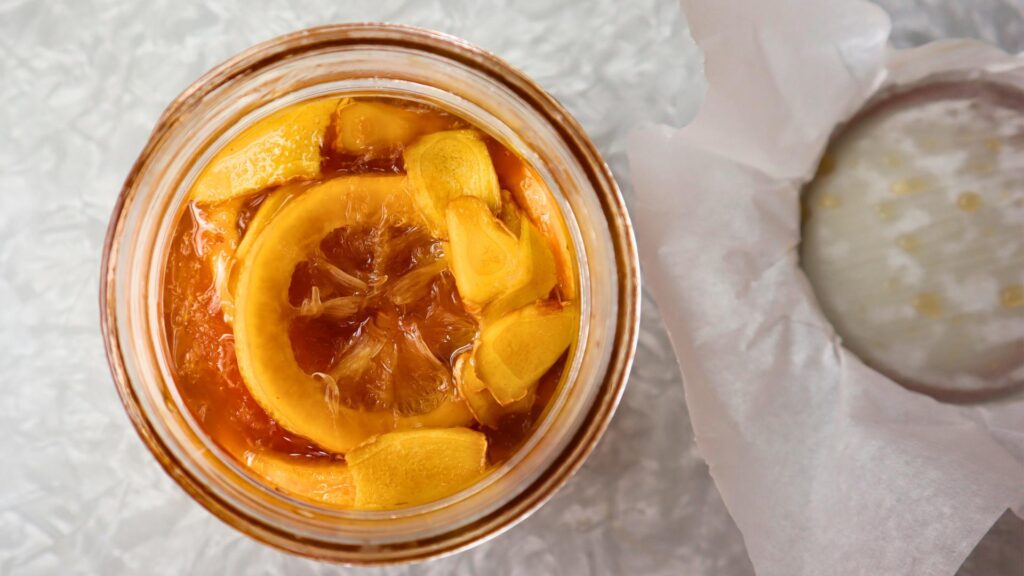
- Slice lemon and add to the jar.
- Thinly slice ginger (peeling optional) and add to the jar.
- Pour raw honey over to just cover.
- Use a spoon to push everything down.
- Place some parchment paper over the opening of the jar, then screw on a lid.
- Once a day, check on it and open the lid to let out any gases that may build up.
- At that time it’s good to then close the lid tight and flip or shake the jar a bit, or press everything down with a spoon.
- You can start using it at anytime. But it’s best after at least 2 weeks or more.
- Store in a cool dark place for a few month as you use it, or move it to the fridge after it’s fermented to your liking for longer storage.
Notes for being successful with your Honey Fermented Lemon Ginger
- Choose a jar that is about twice the size as the amount of food and honey you’re fermenting. This will prevent it from spilling over as it ferments.
- If you can’t find unwaxed lemons you can make this ferment without the peel. Just cut out chunks of the meat of the lemon, discarding any peel and the white pith.
- Use organic ginger if you can find it. I rinse my ginger, but do not peel it. Peeling ginger is hard! The skin is edible, so I don’t waste my time.
- Checking on this ferment daily will insure it doesn’t bubble up and spill over. More than that it will allow you to see the honey fermentation process first hand. Watch for signs of fermentation like small bubbles on the surface, sounds similar to gentle carbonation, changes in the thickness of the liquid, smells developing and changing. All of this information you receive will help you understand the process in a way that no book, article or video can teach you.
- If your raw honey is crystallized and you can’t pour it over the lemons and ginger, place it in a double broiler and slowly heat it on very low stirring often. Don’t heat the honey above about 90 degrees Fahrenheit or it may kill the beneficial bacteria, enzymes and yeast present in the raw honey that we need for fermentation to work.
but what about…
You might notice I’m not sterilizing my jars. That’s because it doesn’t matter! Why? Competitive exclusion. Bad bacteria cannot grow where good probiotic bacteria are thriving. We know we’re setting up an environment that the good guys will love, so there’s no reason to worry about sterilizing anything. We want good bacteria! Sterilization would kill the good and the bad. Besides, there is no way to actually sterilize a jar in your home kitchen, because your home kitchen is alive with bacteria! It’s not a sterile environment (thank goodness). If you boiled your jars and utensils they would be compromised as soon as you remove them from the boiling water.
Don’t get stuck in the fearful details, just learn the process and why it works and you’ll do just fine. To learn more about fermentation you can read this article I wrote all about getting started with fermented vegetables or this one about fermented beverages.
Botulism in Honey Fermented lemon ginger
Nope. Botulism cannot grow in an acidic environment (more here). Honey by itself is acidic, lemon alone is also acidic and even raw ginger is very mildly acidic (source).
Guess what fermentation promotes? The bacterial process eats sugars and tuns them into acids! Fermentation will increase the acidity of the food.
Acidic foods are considered anything with a pH of 4.6 or lower. If you’re super concerned and want some reassurance, buy these pH strips and test for yourself. They are cheap and even make for fun home learning projects for kids.
How long does it take for Honey fermented lemon ginger to ferment?
There is a huge range. A ferment doesn’t have to be “done”, it’s more of a spectrum. As a ferment progresses it will become more acidic, maybe more funky, sometimes a little boozy and all along the flavors will be enhanced and then eventually muted. The texture will also change slowly.
With a honey ferment, there is so much sugar it leaves a lot of food for bacteria and yeast. It will keep working behind the scenes and eventually turn things into alcohol (that’s how mead is made). That will take a long time. I have never kept a lemon ginger honey ferment long enough for it to turn to alcohol. The longest I’ve gone is about six months before we ate it all up!
I have fermented cranberries in honey (Best. Thing. Ever.) and I left a small amount in the jar for over a year and it’s a tad boozy, but still really good. Almost like a thin super sweet cranberry liqueur.
I don’t think this lemon ferment will last that long because of the increased moisture from the juicy lemon. If you like to play it safe, move the ferment to the fridge after some time on the counter to ferment. Whenever it tastes and smells good to you.

Is it safe to leave honey fermented lemon ginger at room temperature?
Yes, as I said above it’s so acidic and has good bacteria there holding down the fort that it will not be able to grow anything that could make someone sick. Just try and keep everything submerged under the honey to prevent mold. If you do see fuzzy mold growing, scrape it off and movie it to the fridge or throw it out if you like playing it safe.
Don’t believe me? Why would you, I’m no doc, scientist or expert. Do a little research yourself, read some of those studies I linked as sources above and stop worrying already!
If I spent more time making things and less time worrying and throwing stuff out when I first started learning fermentation, I would have wasted way less time and eaten even more delicious foods.
pin it for later

Honey Fermented Lemon Ginger | A Simple to Make Pantry Powerhouse
Equipment
- Glass canning jar with lid and band
- Parchment paper
- Cutting board
- Knife
- Vegetable peeler (optional)
- Spoon or spatula
Ingredients
- Raw honey
- Fresh unwaxed lemon
- Fresh ginger
Instructions
- Slice lemon and add to the jar.
- Thinly slice ginger (peeling optional) and add to the jar.
- Pour raw honey over to just cover.
- Use a spoon to push everything down
- Place some parchment paper over the opening of the jar, then screw on a lid.
- Once a day you need to check on it and open the lid to let out any gases that may build up.
- At that time it’s good to then close the lid tight and flip or shake the jar a bit, or press everything down with a spoon.
- You can start using it at anytime. But it’s best after at least 2 weeks or more.
- Store in a cool dark place for a few month as you use it, or move it to the fridge after it’s fermented to your liking for longer storage.
What do you do with the lemons after ferment is done. I’ve used up the liquid and have a jar of lemon slices I don’t want to throw out. I thought about dehydrating but my sheets are plastic canvas. Imagine everything should stick.
Just eat the slices or add to tea? Thanks
I use the lemon slices in tea! It’s super good. You could even eat them whole if you’re into that. I’ve never tried dehydrating them, it would be a cool experiment, but like you I would be worried about the lemons sticking. I would do it on a piece of parchment paper for that reason.
Hi, can a fermentation airlock system be used instead of the parchment paper with lid and band?
Thanks!